The Complete 2026 Report on First Aid and Safety Preparedness for First Aid Trainers
First aid training professionals in the UK bear direct responsibility for ensuring learners can respond competently in life‑threatening emergencies. This report provides a definitive reference for legal compliance, equipment provision, course delivery, certification management, and quality assurance standards applicable in 2026.
This is a decision‑support framework that shows you what risks apply to your training operation, what the law and guidance require, and what you must do, provide, and maintain to demonstrate competence when it matters most.
Who this is for:
Independent trainers, training companies, in‑house training leads, and awarding‑body centres delivering workplace first aid (EFAW, FAW, FAW requalification, annual refreshers, paediatric first aid, and sector‑specific first aid) in UK workplaces.
Table of Contents
High-Quality Training Equipment
Ensure your training sessions are professional and compliant with the latest 2026 standards. From manikins to practice dressings, we provide everything a training professional needs.
Why this matters: Since 2013, the HSE no longer approves first aid training providers, so employers must show they have selected a competent provider against five specific criteria.
Criterion
Your Requirement
Qualified trainers
Trainers/assessors hold a current First Aid at Work certificate or equivalent exemption and have an appropriate training/assessing qualification.
Quality assurance
Documented quality assurance plan, named responsible person, and annual monitoring of trainer/assessor performance.
Current practice
Course content delivered in accordance with current accepted first aid practice (e.g., Resuscitation Council UK and voluntary aid society guidelines).
Suitable syllabus
Training syllabus meets HSE expectations for FAW/EFAW durations and topics relevant to your needs assessment.
Compliant certificates
Certificates show provider, qualification title, reference to Health and Safety (First‑Aid) Regulations, date of issue, and typical validity period.
Consequence of non‑compliance: Training can be treated as invalid, leaving employers exposed to HSE enforcement, increased safety risks, and damaging your reputation.
Action:Implement thenew 2026 resuscitation council UK updates
Why this matters: Since the 2025 Resuscitation Council UK guidelines are now the active national standard, continuing to teach older techniques is no longer compliant with current best practices.
Resuscitation education: Introducing CPR education from early childhood (ages 4–6) and reinforcing it throughout school and professional training, using simulation and gamified learning.
First aid: A new section focused on bystander response, with updated guidance for emergencies including bleeding, choking, overdose, stroke, and trauma.
Basic and advanced life support: Updated advice on chest compressions, defibrillation, airway management, and the role of ambulance call handlers.
Ethics and end-of-life care: Stronger focus on advance care planning, person-centred decision-making, and family involvement during resuscitation.
Systems saving lives: National recommendations for CPR education, public access defibrillators, and long-term support for survivors and their families.
Paediatrics: Updated hand positioning for infant CPR and enhanced guidance on managing critical illness in infants and children.
Newborn resuscitation: Updated guidance on assessment, airway management, use of supplemental oxygen, and new out-of-hospital guidance.
What you must do:
Update all presentations, handouts, manuals, and manikin demonstrations.
Update assessment checklists to reflect 2026 techniques.
Brief all trainers and keep a record of that update in your QA file.
Get Support
Need updated training materials or manikins for 2026?
Why this matters: FAW and EFAW certificates last three years; once expired, the holder cannot be counted as a workplace first aider, and the employer is no longer compliant.
Key Compliance Points
Certificates expire exactly three years after issue.
There is no grace period in law or HSE guidance.
Requalification options depend on the length of expiry.
Requalification Standards
FAW: 2‑day course if expired < 1 month; otherwise full 3‑day course.
EFAW: Full 1‑day (6‑hour) course required in all cases.
HSE Recommendation: 3‑hour annual refresher for all first aiders.
Trainer Action
Use a tracking system and send renewal reminders 6 months and 1 month before expiry so clients stay covered and compliant.
2. Training equipment and supply standards
Action:Ensure there are enough manikins for the amount of trainees
Why this matters: Too few or poorly maintained manikins reduce hands‑on practice and increase infection risks, which learners and employers will notice.
Action:Provide enough AED trainers and bleeding control items
Why this matters: AED use is expected content on FAW and EFAW, and bleeding control is now explicitly included in updated first‑aid training standards.
AED Trainers:
Aim for 1 AED trainer per manikin (1 per 4 learners).
Check operation before each course and replace batteries quarterly.
Bandaging & Bleeding:
One training bandage per learner and enough triangular bandages for slings.
Use training-only, non-sterile, reusable bandages for efficiency.
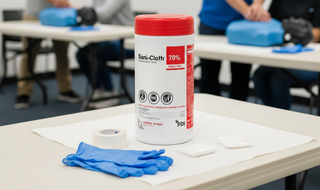
Action:Use nitrile gloves and proper wipes
Why this matters: Using the same products you recommend for workplace use reinforces good practice and reduces allergy and infection risks.
2A. Core supplies every first aid trainer should hold
Action:Standardise a “trainer kit list” so every course runs smoothly
Why this matters: Turning up with incomplete or inconsistent kit undermines confidence, slows the course down, and makes it harder for learners to practise enough to build real competence.
Specialised manikins with realistic airway resistance and QCPR feedback on depth, rate, recoil, and ventilation volume. Essential for paediatric certification.
Spare batteries and pads (AED trainers, clickers, timers)
Timers or stopwatches to run drills/CPR cycles
Practical tip: Create a standard packing checklist for every trainer, and require them to tick and sign before leaving for each course, so omissions are picked up in advance.
2B. Hygiene, infection control, and cleaning supplies for courses
Action:Apply strict hygiene and infection control procedures during all training sessions
Why this matters: Delegates will judge your professionalism by how clean your equipment is, how you manage shared manikins, and whether you visibly apply the same hygiene standards you promote for the workplace.
Clearly labelled simulated blood/colouring with disposable coverings.
Pro tip: Use incontinence bed pads to protect surfaces from simulated spills.
Recommended hygiene routine:
01At the Start
Ask learners to clean hands and explain the manikin cleaning/airway process.
02Between Learners
Wipe faces, chest areas, and high‑touch surfaces with disinfectant wipes.
03Between Sessions
Check/change manikin lungs. Dispose of used parts in sealed bags.
04Post Course
Clean equipment, dry before packing, and record in your equipment log.
When you model this consistently in your training, learners are far more likely to reproduce the same standards back in their own workplaces.
3. Course delivery and quality assurance
Action:Aim for 70% practical and 30% theory
Why this matters: First aid is a hands‑on skill; digitally‑based and theoretical teaching produces learners who can describe but not perform critical actions.
Delivery Recommendations:
At least 70% of contact time should be practical work (CPR, recovery position, bandaging, scenarios).
No more than 30% should be classroom theory.
Online‑only training is not acceptable for workplace FAW/EFAW (no observed skills assessment).
Blended Learning Criteria:
Blended learning is acceptable only if:
Learners complete self‑paced online theory first.
They attend an in‑person practical day with structured skills assessment.
Recommended maximum class size: 12 learners per trainer for FAW, EFAW, and FAW requalification.
Action:Build a simple, documented QA system
Why this matters: A documented quality assurance (QA) framework is one of HSE’s core competence criteria for selecting a trainer, and underpins consistent delivery across trainers and venues.
QA Activity
What You Must Do
Frequency
Evidence to Retain
Learner feedback
Collect written feedback at the end of each course and review for recurring themes.
Every course
Completed feedback forms and a short summary of actions taken.
Trainer monitoring
Observe each trainer delivering a course and provide structured feedback.
At least once per year per trainer
Observation reports, feedback notes and any improvement plans.
Complaints management
Operate a written complaints procedure and log all complaints received.
Ongoing
Complaints policy, complaints register and documented outcomes.
Assessment and certification records
Maintain accurate attendance and assessment records for every course.
Retain for three years
Signed registers, completed assessment sheets and certificate issue logs.
Equipment inspections
Check manikins, AED trainers and consumables to confirm they are safe and serviceable.
Monthly and before courses
Completed equipment checklists and up-to-date stock records.
Requirement: Appoint a QA lead with FAW (or clinical equivalent) plus assessor/verifier training, and schedule internal audits quarterly.
Action:Use realistic scenarios, not just isolated skills
Why this matters: Scenarios force learners to join up skills, communication, and decision‑making, which is how real incidents unfold.
Someone Collapses
Office worker collapses and is not breathing: Focus on scene safety, 999 call, CPR, and AED deployment.
Warehouse Trauma
Warehouse injury with severe bleeding: Focus on hazard control, immediate bleed control, and shock management.
School Emergency
Child choking in a school: Focus on recognition, back blows, and age‑appropriate chest thrusts.
Tailor scenarios to your clients: Whether it's construction, manufacturing, education, retail, hospitality, or janitorial services—ensure delegates can see themselves using the skills in their specific environment.
4. Training content and syllabus requirements
Action:Teach adult, child, and infant CPR accurately
Why this matters: Incorrect hand positions, depths, or sequences can make CPR ineffective or cause harm, particularly in children and infants. The details below are correct as per the Resuscitation Council UK.
Aspect
Adult
Child (1–Puberty)
Infant (<1 Year)
Hand position
Two hands centre of chest.
One hand centre (two if needed).
Two fingers centre of chest.
Depth
5–6 cm.
Around 5 cm (~1/3 depth).
Around 4 cm (~1/3 depth).
Initial action
Start compressions.
5 rescue breaths first.
5 rescue breaths first.
Compression:breath
30:2.
30:2.
30:2.
Rate
100–120/min.
100–120/min.
100–120/min.
Note: Workplace EFAW/FAW focuses on adults; child-facing roles require Paediatric First Aid courses.
Action:Embed the ABCDE Assessment Framework
Why this matters: The ABCDE approach gives learners a consistent way to assess casualties without fixating on one obvious problem and missing something life‑threatening.
A - Airway
Is it open and clear? Use head tilt/chin lift or jaw thrust.
B - Breathing
Is breathing normal? Look, listen, and feel for up to 10 seconds.
C - Circulation
Catastrophic bleeding or shock? Control major bleeding first.
D - Disability
Check consciousness (AVPU) and neurological issues.
E - Exposure
Look for other injuries or risks while maintaining warmth.
Action:Cover all required EFAW and FAW topics
Why this matters: Employers rely on these qualifications to meet their legal duties. According to the HSE, EFAW enables emergency response for injuries/illness, while FAW provides wider coverage.
Typical EFAW core content:
Role and responsibilities of the first aider.
Unresponsive casualty & recovery position.
Adult CPR and AED use.
Adult choking management.
Wounds, bleeding, and shock.
Minor injuries (cuts, burns, splinters).
Typical FAW core content:
Bone, muscle, and joint injuries (inc. spinal).
Chest injuries and serious trauma.
Burns (including chemical burns).
Eye injuries and chemical exposures.
Poisoning management.
Anaphylaxis and auto‑injectors.
Major illnesses: heart attack, stroke, asthma, diabetes.
Extended Content & Best Practice:
Many providers include topics beyond the minimum HSE syllabus to better prepare learners for real-world scenarios:
Action:Ensure every certificate contains all required elements
Why this matters: Certificates are the key evidence employers rely on; missing information can cause problems in an inspection or investigation. Missing elements can cause HSE or insurers to question the validity of the training.
Mandatory Certificate Elements:
Name of the training organisation.
The candidate’s full name.
Qualification title (e.g., FAW or EFAW).
Reference to Health and Safety (first aid) Regulations (1981).
Validity period (three years).
Commencement/Issue date.
Confirmation of delivery against current first-aid practice.
Outline of topics/additional elements covered.
Action:Proactively monitor expiry dates and manage requalification
Why this matters: A common compliance gap is “we didn’t realise our first aiders’ certificates had expired”. Proactive management ensures continuity of coverage for your clients.
Good Practice Workflow
Maintain a central database of learner names, course types, and dates.
Automate reminders at 6 months and 1 month before expiry.
Coordinate requalification clusters for large corporate clients.
Provide clients with tracking templates for their internal records.
Requalification Standards Summary
Certificate Status
FAW Requalification
EFAW Requalification
In date
2‑day (12‑hour) FAW requalification.
Full 1‑day EFAW.
Expired <1 month
2‑day FAW requalification (3 days recommended if skills unused).
Full 1‑day EFAW.
Expired >1 month
Strongly recommended to repeat the full 3‑day FAW.
Full 1‑day EFAW.
★
Best Practice Suggestion: Offer an optional 3‑hour annual refresher covering CPR/AED, choking, ABCDE updates, and scenario-based drills to keep skills sharp between certifications.
6. Maintenance, audit, and compliance
Action:Teach clients how to maintain first aid kits
Why this matters: A well‑stocked, in‑date, accessible first aid kit is the most visible sign of compliance to staff and inspectors alike. As a trainer, using a real kit in your demonstrations provides lifelike training and builds learner confidence.
Action:Stress the importance of recording incidents
Why this matters: Good records support legal defence, show trends, and encourage learning. First aid incidents should be recorded in a paper or secure digital log, stored in line with GDPR.
Mandatory Record Details:
Date, time, and location.
Casualty's name and contact details.
Description of the injury/illness.
Treatment provided.
Name and signature of the first aider.
Retained/Archived for 3+ years.
Action:Run internal audits on your training business
Why this matters: Internal audits catch problems before clients or regulators do and demonstrate professionalism.
Audit Area
Frequency
What to Check
Trainer qualifications
Annually
FAW or clinical registration, teaching certificate, annual assessment.
Common challenges for autistic and other neurodivergent learners include sensory overload, anxiety about role‑play, complex multi‑step tasks, and unfamiliar environments.
Recommended Adaptations:
Send a clear timetable and outline of activities before the course.
Provide written and visual instructions alongside verbal explanations.
Allow private role‑play or one‑to‑one assessment rather than group performance.
Offer flexible breaks and access to a quiet space.
Deliver content in shorter, modular blocks where feasible.
Pro Tip: Use a short pre-course learning preferences questionnaire to identify needs in advance.
Action:Include language, cultural, and physical accessibility
Why this matters: Employers increasingly expect training that reflects the diversity of their workforce; inclusive delivery becomes a selling point as well as a requirement.
Language & Communication
Offer courses in additional languages based on demand.
Provide translated handouts and certificates.
Use diagrams and demonstrations extensively for ESL learners.
Arrange sign language interpreters for hearing-impaired learners.
Cultural Sensitivity
Respect preferences regarding close physical contact.
Manage sensitivity around mixed-gender partner work.
Offer single-gender pairings or manikin-only practice where needed.
Physical Access
Prioritise wheelchair-accessible venues and facilities.
Provide large-print or Braille materials upon request.
Adapt practical sessions (e.g., CPR on a bed) for those with limited mobility.
Allow additional time for physical tasks and assessments.
8. Future‑proofing: 2026 and beyond
Action:Offer sustainable options that align with client ESG goals
Why this matters: Many organisations now have net‑zero and ESG commitments; sustainable first aid options help them meet those goals and distinguish your service.
Switch to digital manuals and certificates as your default standard.
Strategically combine courses to reduce travel-related emissions and venue resource use.
Action:Use technology to support, not replace, hands-on training
Why this matters: Tech can improve engagement and tracking, but it cannot yet replace practical assessment for compliance. Hands-on skill verification remains the regulatory baseline.
Compliant Blended Approaches:
Pre‑course Online Theory: Interactive videos, quizzes, and case studies.
Classroom Practice: Dedicated time for scenarios and formal face-to-face skill checks.
Emerging Tools:
Feedback Manikins: Real-time QCPR quality data.
Mobile Apps: Post-course refreshers and compliance reminders.
Online Dashboards: Automated certificate and expiry tracking.
Note: Online‑only or VR‑only solutions are not sufficient to demonstrate real‑world competence for workplace first aid under current UK guidance.
9. Actions required now
For first aid training professionals in 2026, the priority is to show that your courses are current, compliant, practical, and inclusive. To achieve this, you should implement the following steps immediately:
Professional Compliance Roadmap
1
Align all content with the Resuscitation Council UK updates, including ABCDE and infant choking changes.
2
Document how your organisation meets HSE’s five competence criteria within your quality assurance system.
3
Maintain manikin and AED trainer ratios and hygiene standards that stand up to professional scrutiny.
4
Deliver at least 70% of classroom time as hands‑on practice, utilising realistic, industry-specific scenarios.
5
Track certificate expiries and actively manage requalification and refreshers for your clients.
6
Run regular internal audits on trainers, equipment, and assessment records.
7
Systematically adapt for neurodivergent, language‑diverse, and disabled learners.
8
Introduce at least one sustainable product or process change and promote its benefits to your clients.
Expert Guidance from Steroplast
If you need help understanding exactly what supplies and equipment you need to install, Steroplast can help. We’re a leading healthcare, first aid, and medical supplier in the UK, serving thousands of training organisations to help them stay safe and compliant.
Stay current with 2026 standards. Steroplast provides smart manikins, reusable training bandages, training AEDs, and specialist kits for the professional trainer.