The Complete 2026 Report on First Aid and Safety Preparedness for Construction & Site-Based Contractors
The Complete 2026 Report on First Aid and Safety Preparedness for Construction & Site-Based Contractors
Construction and site-based contractors carry legal, moral, and operational responsibility for the health, safety, and welfare of employees, subcontractors, visitors, and the public across some of the UK’s highest-risk working environments.
This report provides a single, authoritative reference for meeting healthcare, first aid, health and safety, and emergency preparedness responsibilities on active construction sites in 2026. It shows you which risks apply, what the law requires, and what you must do, provide, and maintain to demonstrate competence when it matters most.
Construction contractors, site managers, supervisors, and health & safety leads responsible for workforce safety, compliance, and incident response on active UK construction sites.
Contents Table

Site-Ready First Aid and Emergency Equipment
From workplace first aid kits and eyewash to burns kits, trauma supplies, PPE, signage, and AEDs, Steroplast can support contractors who need to stay compliant, practical, and ready for real incidents on site.
Browse Steroplast’s Range1. Environment & Risk Context
Why this matters: According to the HSE, construction is the UK’s deadliest sector. In 2024/25, 124 workers were killed in work-related accidents in Great Britain, including 35 in construction, the highest number of any industry. Falls from height remained the leading cause of fatal workplace injury.
High-Frequency Risks
You will encounter these:
- Cuts, lacerations, and puncture wounds from tools, materials, fixings, glass, and metal
- Slips, trips, and falls, especially in winter and on changing access routes
- Eye injuries from dust, debris, cement, and cutting or grinding work
- Burns and scalds from hot works, chemicals, hot surfaces, and electrical contact
- Musculoskeletal injuries from manual handling, awkward movement, and falls
- Head injuries from falling objects, collisions, and work at height
Low-Frequency, High-Impact Emergencies
Rare, but critical:
- Catastrophic bleeding from machinery, falling glass, or sharp structural materials
- Cardiac arrest, where survival falls sharply without rapid defibrillation
- Crush injuries and entrapment involving plant, excavation, or collapse
- Falls from height with spinal injury, major fractures, or multi-system trauma
- Electrical contact injuries causing burns, cardiac disruption, or neurological damage
Winter and Seasonal Risk Factors
| Seasonal factor | Why it matters on site |
|---|---|
| Ice, frost, and wet surfaces | Slip and fall risk rises sharply, especially on scaffolding, ladders, access routes, and temporary walkways. |
| Cold hands and reduced dexterity | Grip failures, dropped materials, and tool-related injuries become more likely. |
| Reduced daylight | Poor visibility increases trips, collisions, and missed hazards around site changes. |
| Cold stress and exposure | Workers exposed for long periods can develop cold stress or hypothermia. |
| Bulky winter clothing | Restricted movement and reduced visibility can affect safe working and emergency response. |
Practical takeaway: This is when you should make sure first aid boxes are fully stocked, cold-weather PPE is available, and thermal protection such as foil blankets, survival bags, or emergency jackets is accessible on site.
2. UK Legal & Regulatory Framework
Why this matters: In the UK, health and safety offences can result in unlimited fines, and for the most serious offences the starting point for large organisations can be several million pounds. Directors and senior managers can also be prosecuted personally where consent, connivance, or neglect is involved.
Core Legislation
| Law | Requirement | Construction implication |
|---|---|---|
| Health and Safety at Work Act 1974 | Employers must protect employees and others from work risks and ensure health, safety, and welfare so far as reasonably practicable. | You owe a duty of care to employees, subcontractors, visitors, and the public affected by site activities. |
| Health and Safety (First-Aid) Regulations 1981 | Provide “adequate and appropriate” first aid equipment, facilities, and personnel based on a needs assessment. | Provision must reflect site size, hazards, remoteness, layout, and shift patterns. |
| CDM Regulations 2015 | Principal contractors must plan, manage, monitor, and coordinate health and safety during the construction phase. | First aid arrangements should form part of the construction phase plan and welfare set-up. |
| RIDDOR 2013 | Report fatalities, specified injuries, over-7-day incapacitations, and dangerous occurrences. | Failure to report can itself be a criminal offence, alongside the underlying health and safety failings. |
First Aid Needs Assessment
Mandatory before you buy equipment. Every site should have a documented first aid needs assessment considering:
- Nature of work: hot works, work at height, confined spaces, plant, chemicals
- Workforce size and composition: employees, subcontractors, agency staff, visitors
- Site layout and access: distance from workface to first aid point
- Remoteness from emergency services and realistic ambulance access
- Shift patterns and working hours, including out-of-hours cover
- Hazardous substances such as cement, solvents, or acids
- Previous incident history and recurring problem areas
Legal Minimums vs Best Practice
| Area | Legal minimum | Recognised best practice for construction |
|---|---|---|
| First aid kit standard | HSE-style minimum contents based on your assessment | BS 8599-1:2019 kits sized by workforce and risk profile |
| High-risk site contents | Whatever the assessment identifies | Supplement with burns, eyewash, trauma, and exposure protection as standard on many active sites |
| AED provision | Not generally mandatory | Strongly consider one where exertion, electrical hazards, workforce age, or site remoteness increase risk |
| Training level | Appointed person may be lawful in very small low-risk scenarios | EFAW minimum, with FAW preferred for most live construction environments |
| Kit checks | Regular checks required | Documented monthly checks, plus immediate replenishment after use |
Minimum provision option
Steroplast HSE Approved First Aid Kit reflects traditional baseline workplace provision and suits smaller or lower-complexity site arrangements where the assessment supports it.
Preferred workplace option
Steroplast Workplace First Aid Kit Premier Box (BS 8599-1:2019) gives a more comprehensive, workplace-focused provision and is usually the stronger fit for active construction risk profiles.
3. First Aid Provision & Workplace Preparedness
Why this matters: A kit 200 metres away from scaffolders working at height is not adequate and appropriate provision. Real incidents need immediate access, not a long walk back to welfare.
Browse first aid kits, burncare supplies, eyewash equipment, and trauma kits for construction sites, or use the framework below to build provision around actual site risk.
Minimum First Aid Cover Based on Workforce Size
| Workforce size | Minimum BS 8599-1 kit | Minimum first aid staffing |
|---|---|---|
| Fewer than 5 | Small BS 8599-1 kit | At least an appointed person |
| 5–25 | Medium BS 8599-1 kit | At least one Emergency First Aid at Work (EFAW) trained person |
| More than 25 | Large BS 8599-1 kit per 25 employees | At least one First Aid at Work (FAW) trained person |
On construction sites with more than 50 workers, HSE guidance indicates you should have at least one FAW-trained first aider for every 50 workers, or part thereof.
Common Gaps
- One small kit trying to cover an entire multi-trade site
- First aid provision kept in the site office only
- No burns, eye, or trauma provision despite daily exposure to those risks
- Treating the kit as “set and forget”, so contents deplete or expire
Why this matters: Standard first aid kits are not designed to manage the full range of site emergencies. Use BS 8599-1 kits as your baseline, then add specialist provision where the work demands it.
Workplace first aid kits
BS 8599-1 workplace kits give a more complete foundation, including a wider range of wound care, burn dressings, PPE, resuscitation protection, and emergency blanket provision.
Burns provision
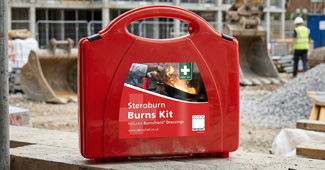
Sites involving welding, grinding, cutting, brazing, torch work, or chemicals need dedicated burncare, not just a general kit.
Eye care and eyewash
Dust, grit, cement, metal particles, and splashes make eyewash and eye care a common compliance necessity.
Bleed control and trauma
High-risk tool, glass, plant, and metal environments should consider trauma kits, haemostatic dressings, and tourniquets.
AED provision
AEDs are not always mandatory, but many sites should justify them in a written risk assessment rather than dismiss them by default.
Exposure and responder PPE
Keep responder supplies such as nitrile gloves, CPR shields, masks, aprons, and sanitising gel with first aid stations.
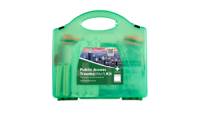
Build Risk-Specific Site Provision
- Use BS 8599-1 kits as your foundation
- Add burns, eyewash, trauma, and exposure protection around real site hazards
- Place supplies near work zones, not just in welfare or the office
- Restock and review them as the site evolves
4. Incident & Emergency Readiness
Why this matters: In a crisis, workers need a clear script and defined roles, not guesswork.
Catastrophic bleeding
Power tools, metal, machinery, and glass can create severe limb injuries and life-threatening blood loss within minutes.
Burns and chemical exposure
Hot works, cement, solvents, acids, and eye exposures need fast cooling or irrigation and clear escalation.
Falls from height
Potential spinal injury, fractures, internal trauma, and airway compromise demand calm scene control.
Cardiac arrest
Immediate CPR and rapid AED use are the difference between a chance of survival and none.
| Emergency | Main risks | Preparedness | Immediate response |
|---|---|---|---|
| Catastrophic bleeding | Deep cuts from power tools, metal, machinery, and glass | Trauma dressings, tourniquets, haemostatic dressings, responder training | Apply direct pressure, use a tourniquet if bleeding is life-threatening and uncontrolled, call 999, monitor for shock, and keep the casualty warm. |
| Burns and chemical exposures | Hot works, cement, acids, solvents, hot surfaces, eye splashes | Burn dressings, hydrogel, eyewash stations, PPE | Remove the source, cool thermal burns with running water for at least 20 minutes, irrigate chemical eye exposures immediately, apply suitable dressings, and escalate urgent cases. |
| Falls from height | Scaffolds, ladders, roofs, fragile surfaces | Clear rescue and ambulance access plan, trained first aiders, immobilisation capability where appropriate | Do not move the casualty unless there is immediate danger, call 999, maintain airway and breathing, keep them still and warm, and monitor consciousness. |
| Cardiac arrest | Can occur anywhere; electrical work and exertion can increase risk profile | Know where the AED is, how to access it, and who will fetch it | Check responsiveness and breathing, call 999, start compressions, send for the AED, follow voice prompts, and continue until help arrives or the casualty recovers. |
Important: Non-clinical staff can and should be trained to recognise cardiac arrest, call 999, start chest compressions, and use an AED.
Keep emergency response simple: who calls 999, who gets the kit, who gets the AED, who meets the ambulance, and who controls the scene.
The best sites rehearse this before they need it.
5. Training, Competence & Confidence
Why this matters: Equipment without trained, confident people is a stocked box that nobody opens.
FAW vs EFAW — Which Do You Need?
| Area | Emergency First Aid at Work (EFAW) | First Aid at Work (FAW) |
|---|---|---|
| Duration | 1 day (6–7 hours) | 3 days (18 hours) |
| Scope | Basic life-saving skills including CPR, choking, bleeding control, shock, and minor injuries. | Covers all EFAW content plus fractures, spinal injuries, burns, eye injuries, poisoning, and medical conditions. |
| Suitable for | Lower-risk sites, or as a supplement to FAW holders. | Higher-risk environments, including construction. |
| Certificate validity | 3 years | 3 years |
For construction sites, HSE guidance states that sites with 5–50 workers need at least one first aider trained in EFAW or FAW, depending on the type of injuries that may occur. Sites with more than 50 workers need at least one FAW-trained first aider for every 50 workers, or part thereof.
Recommendation: On any active construction site with significant hazards, at least one person per shift should hold a full FAW certificate.
EFAW alone may not equip someone to manage the full range of injuries construction work can produce. Build in redundancy as well — think about what happens when your sole first aider is on leave, off sick, or working in another zone of a large site.
Why this matters: Common confidence gaps on construction sites include tourniquet use, AED use, moving casualties with suspected spinal injuries, and knowing when to call 999.
Toolbox talks
Include first aid awareness in toolbox talks and keep them brief, practical, and scenario-based.
Annual practical refreshers
Run hands-on refreshers with tourniquets, AEDs, and burn dressings at least annually.
Visible guidance
Display clear instructional signage at first aid points showing step-by-step actions.
Response culture
Make it clear that acting promptly is always better than waiting for someone else to take over.
6. Maintenance, Audits & Site Mobilisation
Why this matters: A first aid kit that has not been checked is a liability, not an asset.
Recommended Check Schedule for Construction Sites
| Action | Frequency | Who |
|---|---|---|
| Visual inspection of all first aid kits | Weekly | Appointed person or site supervisor |
| Full contents check against inventory | Monthly | Appointed person |
| Expiry date review for eyewash, burn gel, dressings, and wipes | Monthly | Appointed person |
| AED status check, including pads and battery expiry | Weekly | Appointed person |
| Restock after any use | Immediately | Appointed person |
| Document every check in the site log | Every check | Appointed person |
Common items that expire or deplete fast
- Adhesive plasters
- Sterile eyewash
- Burn gels and hydrogel dressings
- Sterile wound dressings
- Antiseptic and saline wipes
- Nitrile gloves
Useful restocking tips
- Keep first aid refill packs in site stores
- Assign restocking responsibility to a named individual
- Mark each kit with the date of last inspection
- Restock immediately after use and log the incident
Why this matters: Moving onto a new project is the ideal moment to reset your first aid provision. This is a low-effort, high-impact compliance win.
7. Future-Proofing (2026 and Beyond)
Why this matters: Expectations around site-level preparedness are increasing, driven by client audit pressure, sustainability targets, and growing visibility of bleed control in public policy.
Evolving preparedness expectations
- PAcT and bleed control readiness are gaining more attention across higher-footfall and publicly accessible environments.
- Pre-qualification questionnaires increasingly ask about AEDs, trauma kits, and trained personnel ratios.
- Sentencing guidance makes it clear that documented “reasonable steps” matter.
Sustainability and responsible sourcing
- Eco-friendly first aid kits with reduced plastic packaging and recycled containers
- Biodegradable nitrile gloves offering barrier protection with lower environmental impact
Accountability and audit readiness
- Inspectors increasingly expect a documented first aid needs assessment, not just equipment.
- Digital check logs and photo records are becoming normal practice.
- Evidence of maintenance, training, and review is one of the clearest ways to demonstrate control.
Practical future-proofing move: For contractors with sustainability targets or clients with environmental commitments, eco-friendly first aid provision is one of the simplest ways to show responsible sourcing without changing the overall safety objective.
8. What to Do This Month
Use this as your immediate action list: