|
Steroplast Resusciade Face Shields – Roll of 36 – Disposable CPR Barrier with One-Way Valve for Infection Protection
£8.64
£7.20
Protect yourself and the casualty with a resusciade face shield when providing CPR. The safest way to practice mouth-to-mouth resuscitation, reducing the risk of cross-contamination.
Select Option ⚙
- Single Face Shield | Keyring Pouch
- Roll of 36 Face Shields
Remember to 'Add to Cart' any items you wish to purchase before exploring other types of products.
Availability:
In stock
SKU
9590




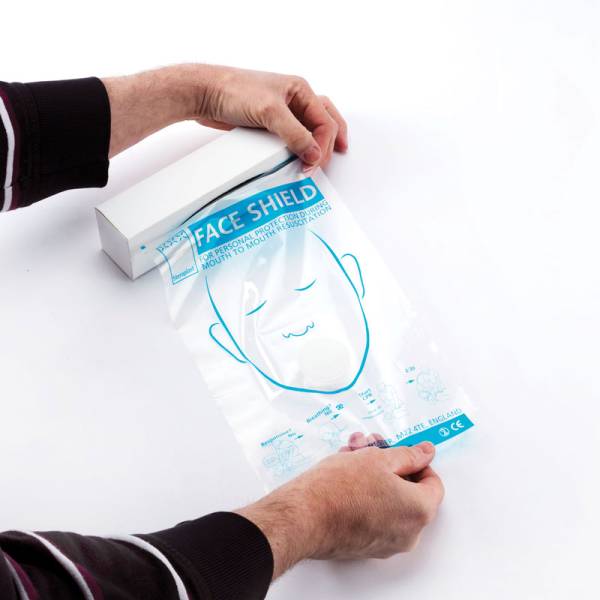
Resusciade face shields are an essential part of emergency resuscitation equipment. These disposable single-use face shields are made from a transparent plastic film, printed with an illustration of a face on the front to indicate where it should be placed on the patient. They are fitted with an oval-shaped mouthpiece designed for a good fit to a casualty’s mouth with a gauze filter forming a barrier over the airway.
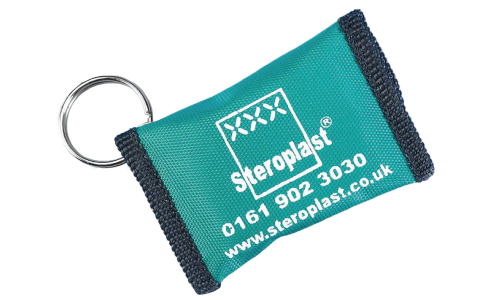
These resusciade face shields come in a roll of 36, ideal for keeping multiple first aid kits well-stocked or for CPR training days for multiple rescuers to practice mouth-to-mouth resuscitation quickly and safely. Steroplast also stocks individually wrapped sterile face shields to keep in a first aid kit, a pocket mask to keep on your person at all times, as well as a handy resusciade keyring.
Why is it important to use a resusciade?
First responders, emergency service staff, and all CPR-trained individuals will benefit from having access to a resusciade face shield in the event of an emergency. These simple to use disposable face shields form a protective barrier between the casualty and rescuer, enabling them to give mouth-to-mouth resuscitation without fear of transmission of infection through cross-contamination.
The timely and accurate provision of CPR procedures saves lives. Keep the rescuer and the casualty safe from the risk of infection and possible illness while providing life-saving care to an unconscious, non-breathing casualty. In some cases, the correct use of a resusciade can improve the quality of rescue breaths.
Using a resusciade minimises the risk of transmitting infectious diseases such as HIV, Herpes and Hepatitis B because it ensures no contact is made with the patient’s face or fluids while breathing into their airway. The one-way valve lets air through, and the transparent film minimises the risk of infection through direct contact.
NHS Guidance on CPR
If a resusciade face shield is available, place it over the patient’s face before starting step 1.
CPR with rescue breaths
- Place the heel of your hand on the centre of the person's chest, then place the palm of your other hand on top and press down by 5 to 6cm (2 to 2.5 inches) at a steady rate of 100 to 120 compressions a minute.
- After every 30 chest compressions, give two rescue breaths.
- Tilt the person's head gently and lift the chin up with two fingers. Pinch the person's nose. Seal your mouth over their mouth and blow steadily and firmly into their mouth for about 1 second. Check that their chest rises. Give two rescue breaths.
- Continue with cycles of 30 chest compressions and two rescue breaths until they begin to recover or emergency help arrives.
Where should you install a roll of resusciades?
This great value roll of 36 resusciades is ideal for corporate CPR training courses with a large number of attendees as it ensures a hygienic barrier is created during CPR training with a resuscitation manikin.
It would also be suitable in first aid training centres to keep first aid kits well-stocked or in workplaces where staff are required to carry their own first aid kit at all times.
Do you think your workplace or public premises needs a roll of resusciades? They are an essential piece of CPR equipment designed to be used alongside emergency defibrillation using an AED. We cover guidance on workplace defibrillator requirements on our blog if you’re unsure of your legal responsibilities.
If you decide to install a roll of resusciades, consider its positioning in line with these suggestions:
- In an area of high footfall.
- Easily visible to a lot of people.
- Not behind restricted access doors if possible.
- In a place that many people are aware of or can be described quickly, for example, next to the reception desk.
Check out our blog for more information on lifesaving AED procedures and resuscitation equipment, including first aid kits, defibrillators, and CPR and choking guidance.
- How does a defibrillator work?
- When to use a defibrillator
- Safety during defibrillation with an AED
- Defibrillator position and placement: How to get it right
- What are the chances of survival when using a defibrillator?
- How to use an AED: Steps to follow at the critical moment
- Choking
- Dog CPR
Related Blogs
Write Your Own Review