The Complete 2026 Report on First Aid & Safety Preparedness for Manufacturing & Industrial Production Sites
The Complete 2026 Report on First Aid & Safety Preparedness for Manufacturing & Industrial Production Sites
Manufacturing and industrial production sites face a unique and measurable set of first aid and safety challenges that carry both legal and human consequences. In 2024/25, 11 workers died in manufacturing incidents across Great Britain, while an estimated 91,000 manufacturing workers suffered work-related ill health on average each year over 2020/21–2022/23.
This report gives operations managers, health and safety leads, and site owners a single reference point for understanding legal duties, managing credible risks, and ensuring practical preparedness across factories, workshops, warehouses, and processing facilities.
It translates regulation into clear operational decisions and explains what adequate first aid and emergency provision actually looks like in a high-risk industrial environment.
Use it to audit current provision, prepare for inspections, brief procurement teams, or support training and review for responsible persons.
Sections can be read independently or as one complete framework. All guidance reflects UK law as it applies in 2026.
Contents Table
Practical First Aid & Safety Products for Manufacturing Sites
From workplace first aid kits and trauma packs to eyewash, burncare, biohazard kits, sharps disposal, PPE, and AEDs, Steroplast can support manufacturing businesses that need to stay safe, prepared, and compliant.
Browse Steroplast’s Range1. Environment & Risk Context
Why this matters: Manufacturing and industrial production environments present elevated and measurable risk. The fatal injury rate in manufacturing is 0.42 per 100,000 workers, around 1.14 times the all-industry average. Understanding where these risks arise is the starting point for every decision that follows.
Operational environments and exposure
Machinery & plant
Moving parts, entanglement, crushing injuries, deep lacerations, and amputations.
Manual handling
Repetitive lifting, awkward loads, twisting, vehicle loading, and musculoskeletal strain.
Chemical exposure
Welding fumes, solvents, VOCs, silica dust, chemical splashes, and respiratory exposure.
Site movement & access
Forklifts, pallet trucks, delivery vehicles, work at height, confined spaces, and maintenance access.
Each of these activities exposes workers, contractors, and visitors to harm. Frequency and severity together determine what adequate first aid provision looks like on your site.
High-frequency incidents
| Incident type | % of injuries | Typical cause |
|---|---|---|
| Handling, lifting, and carrying | 20% | Repetitive tasks, poor technique, awkward loads, and overexertion. |
| Slips, trips, and falls on the same level | 24% | Contaminated floors, obstructions, housekeeping failures, and poor route control. |
| Struck by moving object | 14% | Dropped tools, ejected materials, unsecured loads, and poor handling controls. |
These are the injuries you will actually see, repeatedly, on real manufacturing sites. They are exactly why BS 8599-1 compliant workplace first aid kits matter: adequate provision means stocking for the incidents that are genuinely foreseeable.
High-impact emergencies
- Contact with moving machinery, accounting for 17% of manufacturing fatalities.
- Falls from height, which remain a leading cause of workplace death across sectors.
- Catastrophic bleeding from machinery lacerations, crush injuries, or amputations.
- Chemical and thermal burns from acid, alkali, hot surfaces, or molten materials.
- Cardiac arrest and sudden collapse, where response time is critical.
Key point: Effective preparedness in manufacturing means planning for both the injuries you see often and the emergencies you hope never happen. Standard provision may be enough for minor wounds, but it is not enough where machinery contact, crushing, chemical exposure, or major trauma are credible risks.
2. Legal & Regulatory Context
UK law places specific, non-negotiable duties on employers. Knowing the difference between legal minimums and recognised best practice helps you make defensible decisions and build provision that stands up after an incident or during inspection.
| Law / regulation | What it requires | Manufacturing implication |
|---|---|---|
| Health and Safety at Work Act 1974 | Employers must protect employees and others so far as is reasonably practicable. | This is the overarching duty behind safe systems, adequate first aid, welfare, training, and risk control. |
| Health and Safety (First-Aid) Regulations 1981 | Requires adequate and appropriate first aid equipment, facilities, and arrangements. | Provision must be based on a first aid needs assessment, not a generic shopping list. |
| RIDDOR 2013 | Mandates reporting of deaths, specified injuries, dangerous occurrences, and over-7-day injuries. | Poor reporting is a compliance failure in its own right and can trigger prosecution. |
| PUWER 1998 | Work equipment must be suitable, maintained, guarded, and used by trained people. | If dangerous machinery exists, serious injury is foreseeable and emergency provision must reflect that reality. |
| COSHH 2002 | Requires risk assessment and exposure control for hazardous substances. | Chemical handling areas need eyewash, spill response, training, and documented controls. |
Legal minimums versus best practice
| Requirement | Legal minimum | Best practice for manufacturing |
|---|---|---|
| First aid kit | Suitably stocked in line with assessment. | BS 8599-1 large kits for high-hazard sites, with additional sector-specific equipment. |
| Personnel | Appointed person may be enough in low-risk settings. | FAW-trained first aiders are the more defensible provision on manufacturing sites. |
| Training | Appointed person training may not be certified. | FAW plus annual refreshers and practical scenario work. |
| AED | Not legally required in most workplaces. | Strongly recommended where cardiac arrest is a credible risk or response times are longer. |
| Trauma equipment | Not specifically prescribed. | Bleed control kits where machinery contact, amputation risk, or major laceration is foreseeable. |
Important: Best practice is often what inspectors, investigators, and insurers expect to see after a serious incident. In high-risk industrial environments, legal minimums alone may not be enough to show that your provision was genuinely adequate.
Common legal and compliance failures:
- Generic needs assessments that do not reflect real site hazards.
- Confusing an appointed person with a trained first aider.
- Poor record-keeping, including missing accident book entries and incomplete reporting.
- Expired, depleted, or inaccessible equipment.
3. First Aid Provision & Equipment Requirements
Provision starts with assessment, not procurement. The law requires “adequate and appropriate” equipment, which means understanding the site, the people, the hazards, and the injury profile first.
Your assessment should cover:
- The workplace: size, layout, multiple buildings, access routes, and distance from emergency services.
- The workforce: employee numbers, shift patterns, contractors, visitors, and lone workers.
- The hazards: machinery, chemicals, manual handling, thermal processes, work at height, and vehicle movements.
- Incident history: what injuries have already happened, where, and how often.
Assessment templates are useful, but the real outcome should be a clear rationale for the number, type, and location of kits and trained personnel. Review it at least annually, and sooner if operations, staffing, or risks change.
Why this matters: The HSE’s suggested minimum list is designed around low-risk workplaces. It is a starting point, not a finished answer for manufacturing sites with machinery, heat, chemicals, or vehicle movements.
HSE guidance suggests items such as a first aid leaflet, sterile plasters, eye pads, triangular bandages, safety pins, wound dressings, and disposable gloves. These help with minor cuts, burns, and musculoskeletal injuries, but they do not address catastrophic bleeding or major trauma.
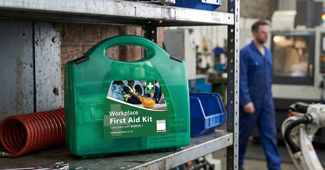
Choose a BS8599-1 First Aid Kit for stronger workplace provision
- The gold standard of workplace first aid kits
- Made to BS8599-1 specifications for UK workplace first aid compliance
- Available in a range of sizes to match workforce size and risk level
- Refills available on product pages
| Workplace type | Employees | BS 8599-1 kit size |
|---|---|---|
| Low hazard | Under 25 | Small |
| Low hazard | 25–100 | Medium |
| Low hazard | Over 100 | Large per 100 employees |
| High hazard (manufacturing) | Under 5 | Small |
| High hazard (manufacturing) | 5–25 | Medium |
| High hazard (manufacturing) | Over 25 | Large per 25 employees |
Manufacturing sites will usually need large kits with higher quantities of trauma dressings, bandages, burncare products, and eyewash. In practice, that often means multiple kits across departments, not a single box in one office.
Supplementary equipment commonly needed in manufacturing:
Chemical hazard areas
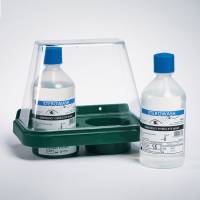
- Eyewash stations
- Eyewash pods
- Burn dressings
- Calcium gluconate gel where hydrofluoric acid risk exists
Machinery contact risk
- Trauma bandages and pressure dressings
- Haemostatic gauze and tourniquets
- Heavy-duty scissors for access through clothing or PPE
Thermal and biohazard risk
- Burn dressings and cooling gels
- Foil blankets
- Biohazard spill kits
- Sharps disposal kits where needed
Placement matters as much as contents: kits must be clearly signposted, quickly accessible, protected from contamination, and positioned where the work actually happens. Multi-floor sites, multiple departments, and lone-working activities all change what “adequate” looks like.
4. Trauma & Bleed Control Preparedness
Standard first aid kits are not designed to manage arterial bleeds, amputations, or severe lacerations from machinery contact. In high-risk manufacturing settings, trauma preparedness is no longer a niche extra — it is increasingly part of what good provision looks like.
Increasingly, sites that provide catastrophic bleed kits alongside standard first aid boxes are seen as better prepared for serious traumatic injuries. After a major incident, the key question will be simple: was the risk foreseeable, and was the provision adequate?
What a trauma or bleed control kit should include
Haemostatic dressings
Gauze treated with clot-promoting agents to help control severe bleeding when packed directly into wounds.
Tourniquets
Emergency devices designed to restrict blood flow from life-threatening limb injuries when pressure alone is not enough.
Trauma bandages
High-pressure dressings for controlling severe bleeding on wounds where a tourniquet may not be suitable.
Support items
Trauma shears, thermal blankets, gloves, CPR protection, and other critical support items for high-pressure incidents.
Ensure emergency readiness with Steroplast’s Critical Injury First Aid Kit
- BS8599-1:2019 compliant trauma kit
- Ideal for high-risk manufacturing environments
- Built specifically for serious bleed response
- Reliable, professional-grade quality
Trauma kits are especially appropriate where:
- Machinery can cause amputation, entanglement, or deep laceration.
- Power tools such as saws, grinders, or presses are used routinely.
- Vehicle movements create crush or run-over risk.
- Confined spaces slow access and evacuation.
- Emergency service response times are longer than ideal.
Why this matters: Trauma equipment is useless without competence. Personnel must know how to recognise life-threatening bleeding, apply direct pressure, escalate to a tourniquet when needed, pack wounds with haemostatic gauze, and communicate clearly with emergency services.
Trauma training is now included in many FAW courses, but manufacturing sites benefit from specific practical modules on catastrophic bleeding and scenario-based response.
Psychological readiness matters as well:
- Maintaining focus under extreme stress
- Prioritising life-saving actions over comfort measures
- Working effectively in the presence of blood, noise, panic, and urgency
5. Training, Competence & Confidence
Ensuring the right equipment provision alone is not enough. Competent and confident personnel determine whether a casualty receives effective care or deteriorates while waiting for paramedics.
| Appointed person | First aider |
|---|---|
| Takes charge of first aid arrangements | Trained to provide treatment |
| Manages equipment and calls emergency services | Administers CPR, controls bleeding, manages shock, burns, and other emergencies |
| Should not provide first aid they are not trained to give | Holds EFAW or FAW training |
| May be enough only where the risk assessment supports it | Expected where the needs assessment identifies meaningful operational risk |
On most manufacturing and industrial sites, appointed-person-only cover is unlikely to be sufficient. Where machinery, chemicals, thermal hazards, vehicle movements, or serious injury potential exist, trained first aiders are the more appropriate and defensible provision.
Emergency First Aid at Work (EFAW)
Duration: Minimum 6 hours
Validity: 3 years
Covers CPR, AED use, choking, seizures, bleeding, shock, and minor injuries.
Suitable for lower-risk workplaces or as extra cover, but often too limited on high-risk industrial sites.
First Aid at Work (FAW)
Duration: Minimum 18 hours
Validity: 3 years
Covers all EFAW content plus burns, eye injuries, fractures, spinal injuries, major illness, poisoning, anaphylaxis, and more.
This is the more appropriate standard for manufacturing and industrial production sites.
Minimum staffing guide
| Hazard level | Employees | Minimum requirement |
|---|---|---|
| Low | Under 25 | Appointed person |
| Low | 25–50 | 1 × EFAW |
| Low | Over 50 | 1 × FAW per 100 employees |
| High (manufacturing) | Under 5 | Appointed person |
| High (manufacturing) | 5–50 | At least 1 × EFAW or FAW, depending on risk |
| High (manufacturing) | Over 50 | 1 × FAW per 50 employees |
These are minimums only. In practice, you also need to think about shift patterns, holidays, sickness, multi-building coverage, contractors, and how quickly a first aider can physically reach the casualty.
Best-practice takeaway: Build in redundancy. One qualified person on paper is not the same as dependable real-world cover.
Annual refresher training, scenario drills, and practical practice with AEDs and trauma equipment all help close the confidence gap.
Common confidence gaps to address in training:
- Reluctance to use trauma equipment such as tourniquets or haemostatic dressings
- Poor communication with emergency services during high-stress incidents
- Failure to secure the scene before treatment begins
- Lack of rehearsal with AEDs, CPR, choking response, and catastrophic bleeding scenarios
6. Maintenance, Audits & Ongoing Compliance
First aid provision is not a one-time procurement exercise. Kits degrade, supplies expire, and training lapses. Ongoing compliance depends on checks, records, clear responsibilities, and timely replenishment.
Weekly visual checks
Confirm each kit is present, accessible, undamaged, and clearly signposted.
Six-monthly detailed audits
Check expiry dates, missing items, condition, and whether risks on site have changed.
Immediate restocking
Replace used items straight away rather than waiting for the next scheduled review.
Items that often expire or degrade:
- Sterile dressings and bandages
- Plasters
- Eyewash pods and solution
- Burn gels and hydrogel dressings
- Saline and antiseptic wipes
- Nitrile gloves
Reportable incidents under RIDDOR must be kept for at least three years. Other first aid records should be retained under a justified policy and handled securely in line with UK GDPR and the Data Protection Act 2018.
Where AEDs are provided, they need weekly visual checks to confirm the ready indicator is active, batteries and pads are in date, and cabinets remain accessible and signposted.
Good practice: assign clear ownership. If nobody is named to inspect, replenish, record, and escalate issues, first aid provision will drift out of date.
7. Emergency Procedures & Response Planning
First aid is only one part of emergency preparedness. Manufacturing sites must plan for fire, chemical spills, machinery failures, medical emergencies, and evacuation, ensuring first aiders, fire wardens, and incident controllers can work together without confusion.
| Role | Responsibilities |
|---|---|
| Incident controller | Takes overall charge, coordinates response, and liaises with emergency services. |
| First aider | Treats casualties, protects scene safety, and hands over clearly to paramedics. |
| Fire warden | Supports evacuation, sweeps areas where appropriate, and helps manage roll call. |
| Technical lead | Provides information on machinery isolation, chemical hazards, utilities, and access routes. |
Roles should be documented, trained, and practised. Do not assume people will know what to do just because they have a job title.
Key emergency planning areas
Assembly points
Must be large enough, accessible, away from the building, and clear of emergency service routes.
Chemical spills
Spill kits, PPE, and COSHH-aligned procedures should be located near storage and handling zones.
Emergency shutdown
Clearly marked isolation points and trained staff are essential before treatment begins in hazardous areas.
Emergency drills should test:
- Fire evacuation time, roll call accuracy, and assembly point suitability
- Medical emergency response time, equipment access, and 999 communication
- Chemical spill response, including PPE and containment measures
- Whether staff can isolate hazards before approaching the casualty
Critical principle: scene safety comes first.
If machinery, electricity, chemicals, or unstable processes are not made safe before treatment starts, responders can become casualties too.
8. Future-Proofing: 2026 and Beyond
Healthcare and safety expectations are evolving. Sites preparing properly for the next few years need to think beyond basic compliance and consider legislative change, public accountability, sustainability pressure, and digital tracking.
Key themes shaping provision
- Martyn’s Law: now raising wider expectations around trauma kits, visible preparedness, and emergency procedures on larger sites.
- Audit pressure: clients and contractors increasingly ask about AEDs, trauma kits, staffing levels, and documented checks.
- Sustainability: demand is growing for lower-plastic kits, responsibly sourced materials, and biodegradable PPE where safe and appropriate.
- Digital compliance: cloud-based check logs, expiry reminders, and smart monitoring tools are becoming more common.
Sustainable first aid options
- Reduced-plastic or paper-wrapped supplies
- Recycled kit containers
- Biodegradable nitrile gloves
Visible preparedness
- AEDs in canteens, reception, or loading areas
- Clear emergency signage
- Trauma kits in higher-risk zones
A sustainable workplace first aid kit solution
- HSE-compliant first aid provision to support your assessment requirements
- 94% reduced plastic, made with responsibly sourced, lower-impact materials
- Maintain high standards of hygiene and care with compliant products
- Align with environmental and sustainability goals across your site
Manufacturing sites that build compliance into operational culture rather than treating it as a periodic task will be in the strongest position for 2026 and beyond.